

What Is Ultrasonic Coffee Cleaning? Understanding Green-Bean Treatment Before Roasting
Ultrasonic technology uses sound waves traveling through water to help clean green coffee beans before roasting. Learn about cavitation, the role of this stage and how LOPHA integrates it into its journey toward pure coffee.
If you have ever looked into an ultrasonic cleaning tank, you may have noticed something unusual: the water looks ordinary, yet very rapid changes are taking place within it. Ultrasonic waves traveling through liquid can create tiny bubbles that form, expand and collapse. This phenomenon, called cavitation, helps explain why ultrasound has been studied and used to clean surfaces with small grooves and hard-to-reach areas.
LOPHA describes ultrasound as a stage used to treat green coffee beans before roasting. That distinction matters: the coffee is not roasted by ultrasound, and the process is not applied to a brewed cup. It may help clean bean surfaces as part of a production process, but it does not replace ripe-cherry selection, post-harvest processing, storage or finished-product quality controls.
1. Why do green coffee beans still need cleaning?
1.1. Coffee beans do not go straight from the tree into the roaster
A ripe coffee cherry goes through harvesting, sorting, pulping, drying and other preparation before its green bean is ready to roast. Along the way, the material contacts equipment, containers, air and the processing environment. Soil, dust or small fragments may be introduced when the stages are not properly controlled. Sorting and cleaning are therefore not cosmetic tasks; they are part of systematic raw-material preparation.
Green coffee beans are not perfectly smooth. The central crease and uneven surface areas may make some adhering material difficult to reach by simple visual inspection. But the presence of a crease does not automatically mean a bean is dirty, nor does it mean all impurities are trapped there. More precisely, surface management is one of several reasons to investigate suitable pre-roasting cleaning methods.
1.2. Sorting, rinsing and treatment have different jobs
Screening and sorting help remove objects of different sizes or bean groups that fail the selection criteria. Rinsing can carry away material that separates easily in water. A properly designed and controlled ultrasonic stage adds mechanical action where water contacts the surface. These operations complement one another because they perform different tasks.
It is important to distinguish a technical objective from a verified result. Adding a machine to the line does not in itself prove that quality has improved by a certain percentage. Frequency, treatment time, energy input and bean characteristics may affect performance. Effectiveness must be measured against suitable parameters under specific conditions. Buyers need not master every setting, but they deserve an accurate explanation of what the technology is intended to do.
2. How do ultrasonic waves work in water?
2.1. Ultrasound is vibration above the normal hearing range
Simply put, ultrasound is mechanical vibration at frequencies above what most people can hear. In a cleaning system, energy is transmitted into water and causes rapid pressure variations. What matters is not whether the beans can ‘hear’ the sound, but the formation and collapse of microscopic bubbles in the liquid under suitable conditions.
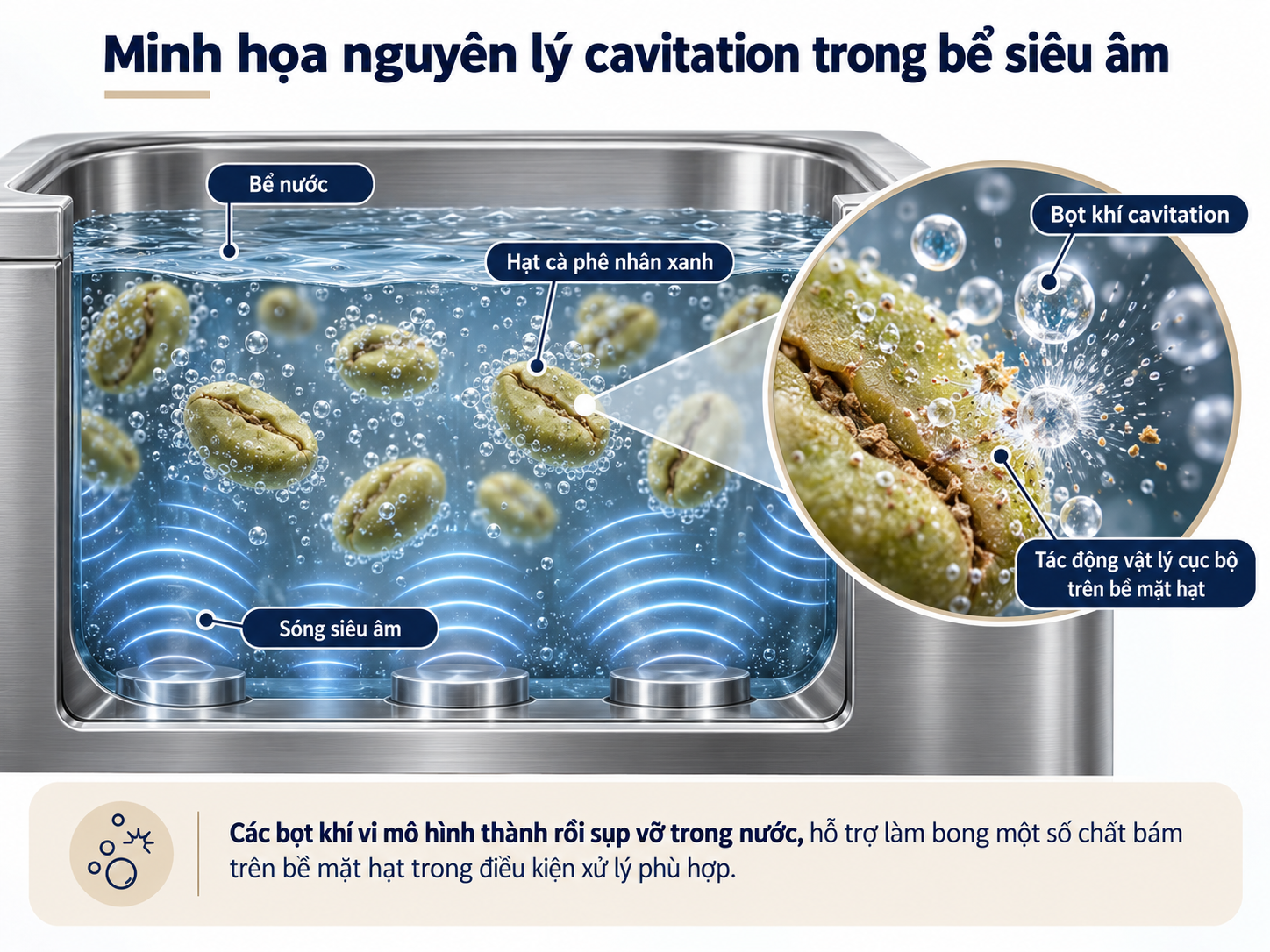
Understanding the mechanism helps prevent assumptions such as ‘the waves penetrate everywhere and remove all dirt’ or ‘ultrasound means water is no longer needed.’ Water, equipment configuration and treatment conditions are all part of the process. Without them, a description may sound advanced while failing to reflect how the equipment really works.
2.2. What is cavitation, and why does it matter?
Cavitation is the formation, growth and collapse of tiny cavities or bubbles in a liquid under suitable pressure changes. When microbubbles collapse near a surface, they can produce localized mechanical effects. This is why ultrasound is used in various cleaning systems involving small components or surfaces that ordinary water flow may struggle to reach.
Imagine cleaning an object covered in fine grooves. Running water may remove visible dust without reaching every recess equally. In an ultrasonic tank, processes within the water can add mechanical action in those locations. This example illustrates the principle only: coffee beans are biological materials, and results from cleaning metal or jewelry cannot automatically be assumed to apply to them.
2.3. Not every ultrasonic process works the same way
Two systems described as ultrasonic tanks may use different equipment, layouts and operating conditions. Bean characteristics, moisture and surface condition also vary between lots. A setting found online should therefore never be presented as an official LOPHA parameter unless internal documentation confirms it.
To understand a specific process, begin with three pieces of information: its objective, its position in the production line and how results are monitored. Microbiological, residue and sensory parameters each require appropriate tests. Cavitation explains *why the technology can have an effect*; testing establishes *how much of that effect has actually been achieved*.
3. Where does ultrasonic treatment fit into LOPHA's process?
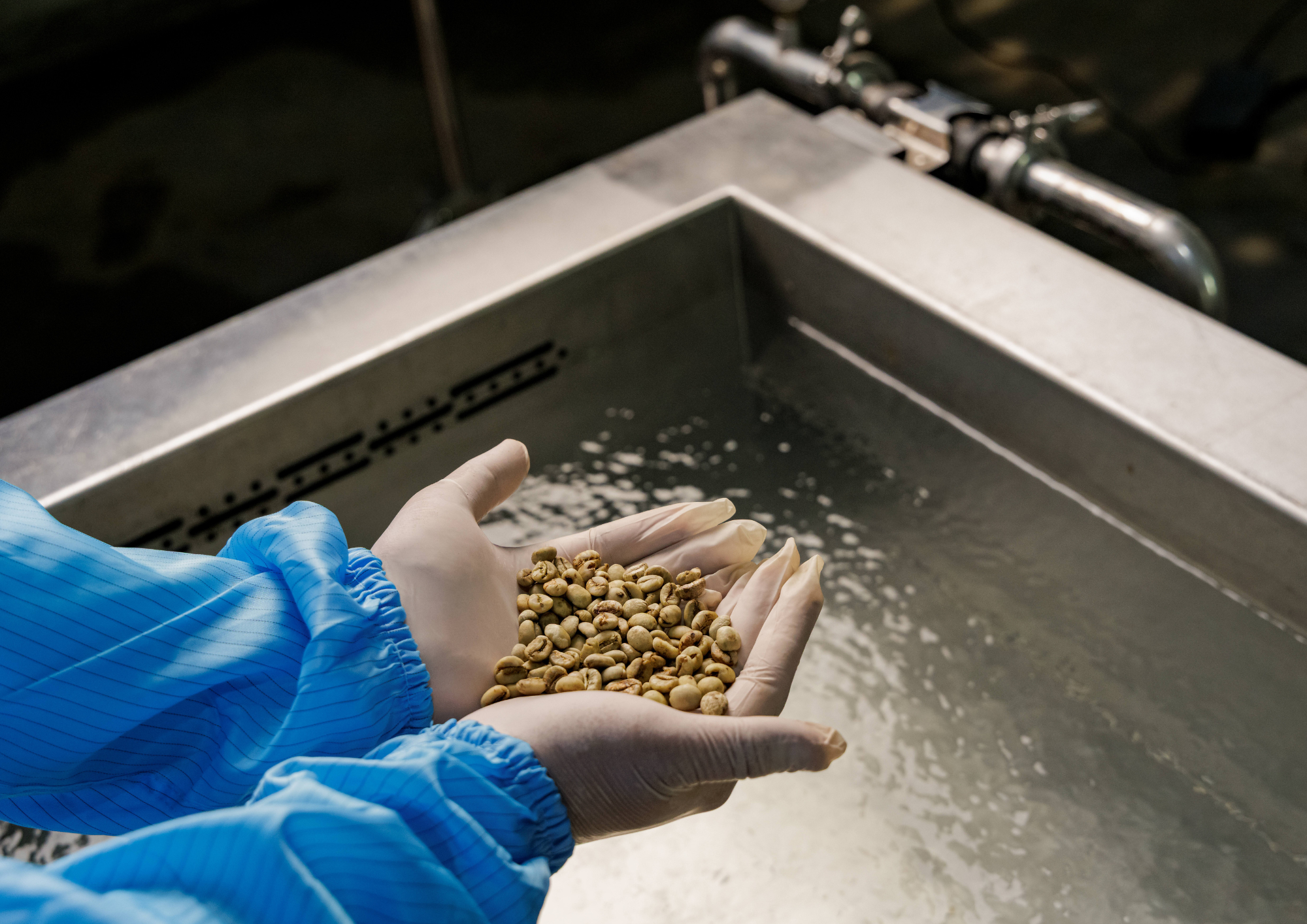
In LOPHA's farm-to-cup production process, ultrasonic treatment takes place on green coffee beans before roasting. Ripe cherries still need processing, sorting and other preparation; treated beans then undergo rinsing, stabilization and later production stages. Seeing this sequence makes the role of the tank easier to understand without assigning it the work of the whole production line.
3.1. The quality of incoming beans remains the foundation
Damaged beans, beans with serious defects or raw materials that were poorly processed or stored do not become ideal simply by passing through an ultrasonic tank. Cleaning has its own specific purpose. Actual bean quality, drying and storage conditions remain important before the equipment receives the raw material.
A cleaning stage should therefore be assessed alongside the quality of the beans entering it. Well-stored, properly sorted materials treated under consistent conditions provide a better basis for factories to monitor differences between batches. Technology performs a particular task and needs consistent operation and verification.
3.2. After ultrasound, beans are rinsed and prepared for roasting
According to LOPHA's published process sequence, ultrasonic cleaning is not the final step. The post-treatment rinse and subsequent preparation stages have distinct roles in readying the beans for roasting. Assuming that simply dipping beans into a tank and removing them completes the job overlooks an important part of the production line.
Once the beans reach roasting, heat-driven reactions develop coffee's characteristic aromas and flavors. Bean quality, roasting and preservation after roasting all shape the eventual cup. Cleaning should not therefore be described as a ‘flavor-creation technology’ that directly determines every tasting note.
4. Does ultrasound completely remove chemicals, mold and bacteria?
Buyers naturally ask this because many advertisements make dramatic numerical claims. It helps to separate three questions: whether a mechanism can help clean the surface, how effective it is against a particular parameter, and whether a claim applies to every finished-coffee lot. These are not interchangeable.
A test showing less dust or a particular adhering substance under certain conditions cannot prove complete removal of every pesticide residue, mycotoxin or microorganism. These groups differ in their properties and testing methods. Percentage claims or statements such as ‘none remains’ require suitable tests, detection limits and data representative of the actual process in use.
Food manufacturers can design quality-control systems in many ways. Ultrasound is one treatment method at a single stage; finished-product quality and safety must be evaluated through the applicable product parameters. A technological distinction is worth understanding, but is not enough on its own to rank brands by safety.
A responsible brand explains the limits of its published data. If a customer wants to check a particular indicator, useful questions include: is there a corresponding laboratory report, when was the sample taken, which product or lot does it cover, and which organization performed the test? Those questions are far more practical than asking for an absolute safety slogan.
5. Does this technology change the flavor of coffee?
Because coffee is enjoyed through aroma and taste, people understandably wonder whether cleaning strips away the bean's natural qualities. A careful answer is needed: pre-roasting treatment may aim to prepare the raw material for subsequent steps, but describing that goal does not directly prove a specific increase or decrease in the cup's flavor.
Flavor depends on many factors: variety, ripeness, post-harvest processing, green-bean moisture, roasting, time after roasting, grind size and brewing. The same coffee may taste noticeably bold in a phin but reveal more aroma through another brewing method. Without a controlled comparison, it is difficult to attribute an impression of ‘clarity’ to a single treatment step.
When holding a finished coffee bag, buyers should read the ingredients, brewing guidance and product information alongside the technology story. Someone who likes bold Robusta with a sweet finish has different preferences from someone who chooses clearly acidic Arabica. Even with the same raw-material treatment, the varieties retain distinct characters. Technology does not make every bag taste the same, nor must everyone enjoy the same cup.
6. How can buyers check claims about the technology?
6.1. Distinguish process diagrams from laboratory results
A process diagram can show which steps come first, where equipment is used and how its technical purpose is explained. A test report answers a different question: what did a sample show for a given parameter using a particular method? A diagram cannot replace measured data, and one laboratory indicator cannot establish every aspect of a product.
For LOPHA's ultrasonic approach, the fact that green beans are treated before roasting distinguishes cleaning from the heat-driven development of flavor. The process and its purpose help readers understand the brand's production direction. Specific claims still require the corresponding technical records and test results. This approach builds confidence without exaggeration.
6.2. What can you ask if you want to know more?
If you are curious, ask three simple questions: at which stage are the beans treated; what happens before and after it; and what results has the company published for the specific product? When these points are explained, technology becomes less of an unfamiliar buzzword and more of an understandable part of the bean's journey.
There is no need to ask for the number of kilohertz or treatment minutes before buying a weekend coffee unless those details are central to your interests. Most customers need clear ingredients, usage instructions, information about the company and consistency in how quality is explained. More technical questions remain an option, not an exam everyone must pass before drinking coffee.
7. Why does understanding the technology help coffee drinkers?
Understanding the technology helps buyers avoid two extremes: treating every new invention as a miracle or assuming that all technology makes coffee ‘unnatural.’ A well-defined stage can be judged calmly through its mechanism and evidence rather than the impression its name creates.
For LOPHA, the meaningful story is a desire to care for the raw materials before roasting and manage production across multiple stages. The finished coffee still deserves to be judged as a real product: its declared ingredients, actual taste, suitability for your brewing method and transparency of information. That is why a Robusta lover and an Arabica lover may both value the process yet choose very different bags.
When technology is described in proportion, it does not stand in front of the cup and hide everything else. It stays behind the scenes as one step in how the producer works. Drinkers gain another way to understand the brand, while the pleasure still begins with a cup that suits their taste on an ordinary morning.