
How Do You Calculate the Cost of One Coffee? From Wholesale Bean Prices to the True Cost of a Menu Drink
The cost of one coffee includes more than beans: milk, sugar, packaging, waste, and other recipe ingredients also matter. Understanding each cost component helps café owners control costs, compare wholesale coffee sources, and assess the performance of individual menu items.
A café receives two coffee quotations: one supplier is VND 15,000 cheaper per kilogram, while the baristas find the other easier to brew consistently. Choosing solely on purchase price may overlook costs that arise at the counter. And dividing a bag's price by the number of drinks and calling it the “cost of goods” only tells half the story.
The cost of one coffee needs to reflect a real menu recipe: how many grams of beans it uses, whether it includes milk or sugar, what takeaway packaging costs, and how often drinks must be remade. Only then can the café see how much of the selling price remains to cover rent, staff, depreciation, and other expenses. The calculations below move from beans to a complete drink and work whether a café is creating a menu or reviewing a new wholesale source.
1. First, define exactly what you mean by “cost of goods”
1.1. Beans are only one part of a finished drink
Suppose an iced coffee with condensed milk sells for VND 35,000. Beans may be the most important ingredient for flavour, but they are not the only expense. Condensed milk, water, ice, takeaway supplies, ingredients discarded after preparation errors, and delivery-platform fees can all reduce the amount remaining.
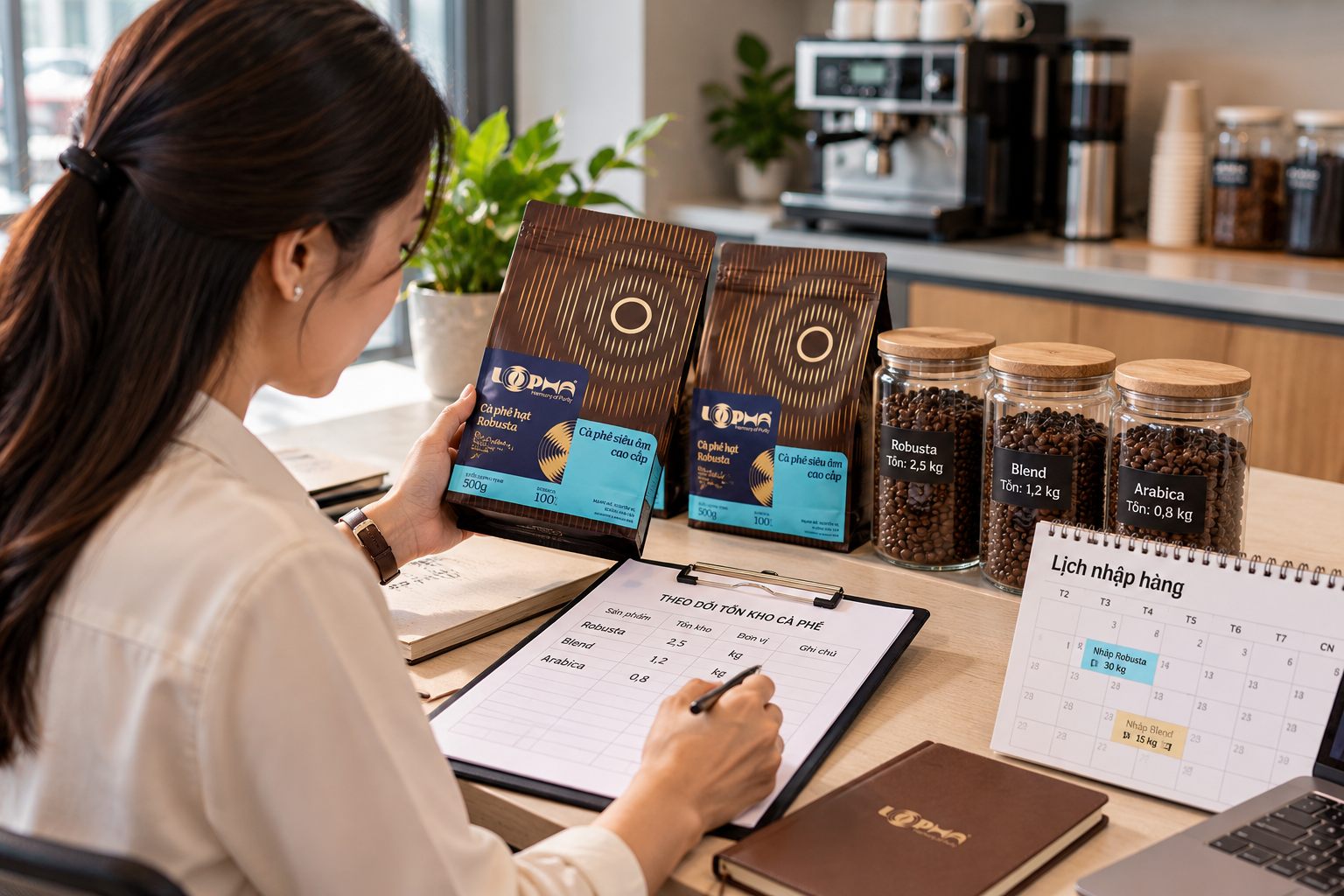
For practical management, separate at least three layers. First are the drink's direct ingredients: coffee, milk, sugar, toppings, water, and ice. Second are variable costs incurred to sell it, including packaging, transaction or platform fees, and waste. Third are shared operating costs such as rent, management salaries, fixed electricity, maintenance, and equipment depreciation. Accounting systems may classify costs differently; what matters is applying one consistent method without omitting or double-counting anything.
For every menu item, list coffee beans, accompanying ingredients, and costs that arise directly with each drink sold as separate lines. This helps distinguish ingredient cost, variable service cost, and profit after all expenses. Mixing these concepts can give a single drink several conflicting “cost of goods” figures without explaining why.
1.2. Distinguish selling price, variable costs, and contribution
A drink priced at VND 35,000 on the menu may not bring the café that exact amount. Delivery apps may charge platform fees or apply discounts funded by the café; VAT treatment also depends on the business's accounting method. For a management worksheet, use a consistent revenue basis and subtract the corresponding variable costs. What remains is a contribution toward shared expenses, not net profit.
For drinks sold through apps, the listed price and the amount actually received can differ because of promotions, platform charges, subsidies, or commercial arrangements. Do not use one selling price and assume the contribution margin is identical across every channel. An over-the-counter drink and the same drink delivered via an app need separate worksheet rows when their fee structures differ.
2. Calculate the bean cost per cup correctly
2.1. Start with a dose that really works for the recipe
The basic formula is: bean cost per brew = price per kilogram × grams used ÷ 1,000. At a hypothetical VND 260,000/kg and a 20 g dose, theoretical bean cost is VND 5,200. If a recipe uses two separate brews, multiply by the correct number; a large latte does not automatically use the same beans as a single espresso.
In practice, reducing a dose from 20 g to 16 g cannot automatically be called a successful saving. If the drink becomes weaker and regular customers no longer enjoy their usual order, a few hundred dong saved on ingredients may not be worth it. First test and finalize a recipe that meets the desired flavour, then compare the bean costs of different options.
When recording beans used during a shift, check those amounts against the number of acceptable drinks sold rather than relying solely on the machine's preset dose. A few days of consistent records also show which activities waste the most coffee: dialling in at the start of a shift, remaking drinks, or switching beans without adjusting the grind.
2.2. Use only one method to account for waste
There are two calculation methods, but choose only one for a given period. If you know the actual bean cost consumed after reconciling stock, divide it by the number of acceptable drinks. If you are forecasting from a standard recipe, divide theoretical bean cost by (1 − waste rate). The second formula is valid only if the waste rate means the share of purchased beans that does not become saleable drinks.
For example, a brew uses VND 5,200 in beans, and 8% of purchased beans are consumed by tests, grinder adjustment, or discarding. Effective bean cost is then approximately VND 5,652. If the café already calculates acceptable cups using the actual quantity purchased and used for the month, do not add another 8%. These are two routes to the same cost, not separate expenses to stack together.
Returned drinks, preparation mistakes, and changes of bean batches should be tracked separately if you want to understand causes. Waste varies by machine, barista, shift, and bean type; an illustrative percentage should not become a universal standard for every café.
3. Add milk, sugar, ice, and supplies according to the menu
3.1. Measure ingredients; do not guess
One barista may pour milk by habit while another fills the spoon more generously, creating different costs for a drink sold under the same name. Record core recipes in grams or millilitres, convert pack prices to a cost per gram or millilitre, and calculate each ingredient accordingly.
Suppose the iced milk coffee being tested contains 20 g of beans, 35 g of condensed milk, plus water and ice as specified by the recipe. If milk costs VND 4,500, syrup or sugar VND 1,000, allocated water and ice VND 300, and beans after waste VND 5,652, estimated ingredient cost is VND 11,452. This is a hypothetical costing exercise, not LOPHA's official iced milk coffee recipe or ingredient price list.
Water and ice may contribute small amounts, but they should be recorded consistently across drinks. At the same time, it is not worth spending hours measuring a tiny cost to the last dong while milk portions still vary between shifts. A costing sheet needs to be accurate enough for decisions, not merely present numbers that look perfect.
3.2. Dine-in and takeaway drinks may have different costs
Reusable dine-in glassware is washed and used again, whereas paper or plastic cups, lids, straws, and bags carry a cost per takeaway order. Suppose these materials cost VND 1,500 per takeaway: total variable cost before other items is VND 12,952. Add any applicable payment fee or café-funded promotion for that sales channel.
For platform sales in particular, establish which price fees are calculated on and who funds promotions. Percentage-based service fees must be applied to the appropriate transaction value. Using a platform's advertised commission rate as a standard for every order can make the forecast inaccurate from the start.
4. A complete example: from wholesale bean price to money remaining
Consider a takeaway iced coffee with condensed milk sold directly over the counter for VND 35,000. Assume beans at VND 260,000/kg, a 20 g dose, an 8% forecast waste rate as defined above, milk at VND 4,500, sugar or syrup at VND 1,000, water and ice at VND 300, takeaway materials at VND 1,500, and VND 1,800 of direct variable labour if the café can measure that cost per drink.

Beans after waste: Illustrative cost per cup: VND 5,652 — How to record it: 5,200 ÷ 0.92; do not add waste again
Condensed milk: Illustrative cost per cup: VND 4,500 — How to record it: According to the recipe dose
Sugar or syrup: Illustrative cost per cup: VND 1,000 — How to record it: According to the menu recipe
Water and ice: Illustrative cost per cup: VND 300 — How to record it: Hypothetical allocation
Cup, lid, and straw: Illustrative cost per cup: VND 1,500 — How to record it: For takeaway orders
Direct variable labour: Illustrative cost per cup: VND 1,800 — How to record it: Include only when measured per cup; do not also count as a fixed cost
Total illustrative variable cost: Illustrative cost per cup: VND 14,752 — How to record it: Excludes payment/platform fees and other expenses
Under these assumptions, direct revenue of VND 35,000 less variable costs of VND 14,752 leaves VND 20,248 per cup, or about 57.9% of the selling price. That amount must still cover fixed costs, administration, depreciation, taxes, and other risks. Calling VND 20,248 the “profit per cup” would give the manager an overly optimistic picture of performance.
If staff are actually paid fixed wages by shift, the café may track those wages under operating expenses instead of assigning VND 1,800 as a variable cost per cup. Both methods can serve different management purposes, but the method must be stated and payroll must not be counted twice. When assumptions change, recalculate the whole table consistently to keep comparisons fair.
5. Compare two wholesale quotations using the same drink recipe
5.1. A lower price per kilogram may not mean a cheaper cup
Two hypothetical coffees show why buying only by price per kilogram can mislead. Sample A costs VND 240,000/kg and requires 22 g per acceptable cup, giving a theoretical bean cost of VND 5,280. Sample B costs VND 265,000/kg and uses 19 g, or VND 5,035. These are not full drink costs because waste and other ingredients remain; however, they show why a café should test real recipes before deciding.
If sample A frequently needs machine adjustments at rush hour while B runs consistently on the café's equipment, waste and operating time also belong in the comparison. Conversely, an affordable bean that is easy to brew and works well on the menu should not be undervalued merely because its marketing story is less elaborate.
5.2. A fair trial keeps selling conditions comparable
When testing samples, keep cup size, milk, ice, and scoring criteria the same; adjust grind size as needed to brew each bean appropriately. Record actual grams used, number of remakes, and acceptable cups. In cafés with multiple shifts, have another barista repeat the test to see whether the recipe is easy to maintain.
The unit prices shown in a retail whole-bean catalogue apply to the listed pack sizes and are not necessarily prices for wholesale contracts. When comparing coffees at the café, use the quoted purchase price for the correct volume and delivery terms, then compare the grams needed for each acceptable cup. Only then does the calculation reflect a real purchasing decision.
6. Can cost data help set a new selling price?
6.1. Understand contribution before choosing a selling price
One common pricing approach is to calculate expected variable cost per drink, choose a required contribution margin, and check whether the resulting price fits the market, customer experience, and café positioning. With a target contribution margin of 60% of net revenue used for the calculation, estimated variable costs should account for no more than 40%. Indicative selling price = variable cost ÷ (1 − target contribution margin).
If a drink has variable costs of VND 15,000 and the café targets a 60% contribution margin on its chosen revenue basis, the calculation gives VND 37,500. But this is only a reference point: the final price also depends on VAT, channel fees, promotions, customer willingness to pay, and the need to cover fixed costs. No single formula guarantees a profitable drink.
6.2. High sales volume cannot always rescue an underpriced drink
A bestseller with high ingredient, packaging, and platform costs can generate substantial revenue but little contribution. Owners should review cups sold, actual revenue received, variable costs, and contribution per item together. Once they see which drinks attract customers and which contribute more, decisions about changing coffee beans become less driven by the feeling that “input costs are rising.”
A sales notebook or simple spreadsheet is sufficient at first. Whenever milk suppliers, cup formats, or bean prices change, update the affected lines before changing menu prices. A worksheet used regularly is more valuable than an impressive template opened only when requesting a quotation.
7. Three ways to keep your costing sheet accurate
7.1. Do not count waste twice
If bean cost is calculated by dividing actual purchased-and-consumed beans by acceptable cups sold, dial-in and failed-brew waste is already included. Adding another line for “8% waste” artificially inflates costs. When forecasting from a standard dose, waste may be included using the percentage formula in section 2.2, but the denominator must be defined.
7.2. Do not subtract pre-VAT purchases directly from post-VAT revenue
Tax treatment can make two numbers appear comparable when they are not. Depending on the VAT reporting method and eligibility for input VAT deductions, the café needs to choose an appropriate way to record revenue and costs and use it consistently. For statutory accounts or tax obligations, consult the responsible professional rather than inferring treatment from an illustrative cost example.
7.3. Do not overlook changes in the menu sales mix
Even if individual drink recipes stay the same, changes in the mix of black coffee, milk coffee, and latte sales will change the café's average cost. Do not keep using the ratios from opening day forever. Updating sales mix by drink group weekly or monthly reveals most meaningful shifts.
8. What should you bring to a wholesale-pricing discussion?
A best-selling drink may become less efficient if a new bean forces staff to remake more cups, even when the purchase price per kilogram falls. When discussing wholesale coffee supply with LOPHA, the café should put three things on the table: its current drink recipes, projected order volume, and dependable delivery terms. Price is only one part of the decision.
Bring monthly cup sales, key menu items, bean doses per recipe, and target bean cost to the supplier meeting. Those details provide a basis for discussing the correct product format, volume-related pricing, and delivery schedule. If changing ingredients, a trial on the actual menu is more reliable than a decision based on a price list alone.
Costing does not replace tasting and selecting beans. It simply shows the owner what each recipe costs and how much revenue remains to sustain the business. When flavour and numbers are considered together, wholesale sourcing decisions become less subjective and more resilient to market changes.