Stabilising Coffee Beans Before Roasting at LOPHA
Summary: Coffee does not go straight into the roaster after ultrasonic treatment and rinsing. The beans first need to reach a suitable condition to respond to heat more consistently. LOPHA refers to this tenth step as bean closing or stabilisation. Its purpose is to prepare the raw material before the flavour-development stage.
Stabilisation comes between rinsing and roasting
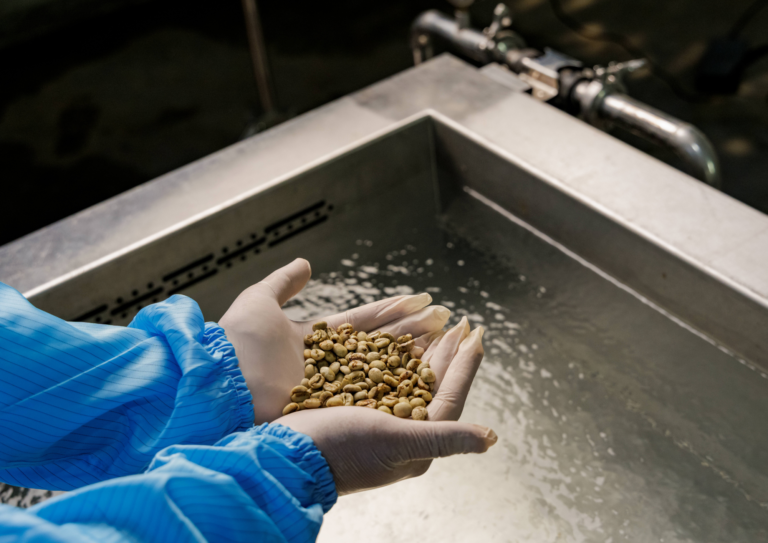
In LOPHA’s factory process, beans pass through a stage called bean closing after ultrasonic treatment and rinsing. This is the brand’s term for a stabilisation stage, not a claim that the bean physically seals itself shut. The process is intended to prepare the raw material for roasting.

Put simply, beans that have just undergone water-based treatment need to be brought into a condition suitable for receiving heat in the roaster. Moisture and bean condition therefore need attention before the next stage begins.
This often-overlooked transition can influence roasting. When a lot of beans is reasonably uniform, the roaster has a clearer starting point. When moisture or condition varies markedly, heat may affect different beans differently, making consistent results harder to achieve.
Beans still contain water even when they look dry
A green coffee bean may feel completely dry on the outside, but that does not mean it contains no water. Coffee is a plant material with a structure that retains moisture internally. The amount and distribution of that moisture matter to later processing, even when the surface does not appear wet.
After stages involving water, the distribution of moisture between the surface and the bean interior may have changed. We should not assume that the beans immediately return to the same condition they had beforehand. Suitable stabilisation is therefore part of preparing them for roasting.
Consider a towel that has just been wrung out. It may no longer drip, yet moisture remains inside its fibres. Beans are not towels, but the comparison helps explain why a dry-looking surface alone cannot establish moisture condition throughout a material.
What can uneven moisture cause?
A roasting batch contains many beans exposed to heat at roughly the same time. Yet individual beans differ in size, structure and moisture content. If a lot contains beans in substantially different moisture conditions, their ability to absorb and transfer heat may vary within the same roast.
Some beans may therefore develop colour or aroma differently from others even when roasted together. Not every variation in a roast comes from moisture alone, but it is one of the factors worth assessing when the result is inconsistent. Managing it before roasting is more sensible than expecting the roaster to compensate for every difference.
At the tenth step, stability is more important than speed. Sending the coffee to roasting as soon as possible may be unsuitable when the beans are not yet in the intended condition. This stage prepares the foundation for the next operation rather than simply delaying production.
Stabilisation is not preliminary roasting
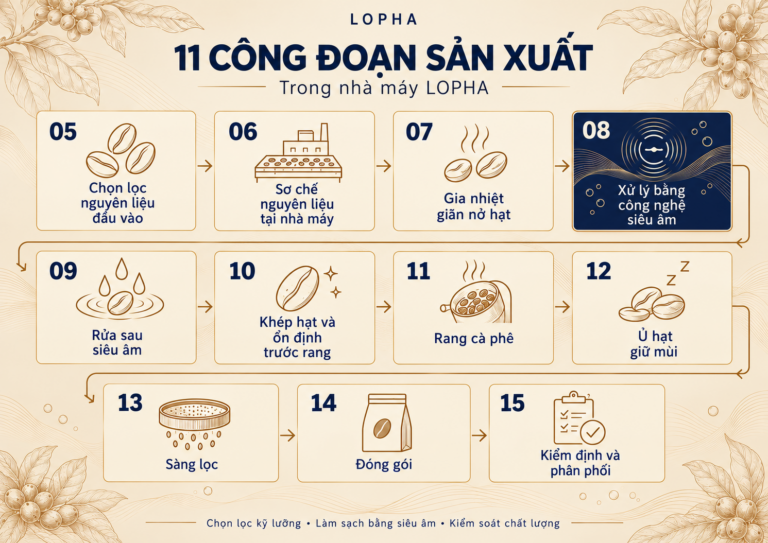
LOPHA has two preparatory stages that newcomers may confuse: heating and expansion before ultrasonics, and bean stabilisation after rinsing. Both take place before roasting but serve different purposes. The former uses controlled heat to prepare the material for specialised cleaning; the latter helps prepare beans after water-based treatment.
Roasting is the stage that develops the characteristic colour and aroma of coffee. During a roast, numerous heat-driven reactions lead to noticeable changes in the beans. Pre-roast stabilisation should not be described as another roasting process, because it does not have the same objective.
LOPHA’s step-by-step sequence makes the purpose of each operation easier to recognise: select the coffee, clean it, apply specialised treatment, stabilise it and then develop its flavour. Treating these tasks as interchangeable would obscure how the production process actually works.
Why pre-roast storage conditions matter
Even stabilised beans can change when exposed to their surroundings. Humid air can cause plant materials to absorb moisture again, while temperature, containers and storage duration may also affect condition. The environment between processing and roasting therefore deserves attention.
Poor storage may undo some of the uniformity that earlier treatment sought to achieve. Imagine carefully preparing a batch of raw material, then leaving it in conditions that allow part of it to absorb moisture or become contaminated. The later stage would inherit those changes, whatever care was taken before.
For LOPHA, the purity journey includes more than moments when equipment is running. Transfers between areas, storage containers and cleanliness at contact points also help preserve the condition of coffee until it reaches the roaster.
How can bean condition be assessed?
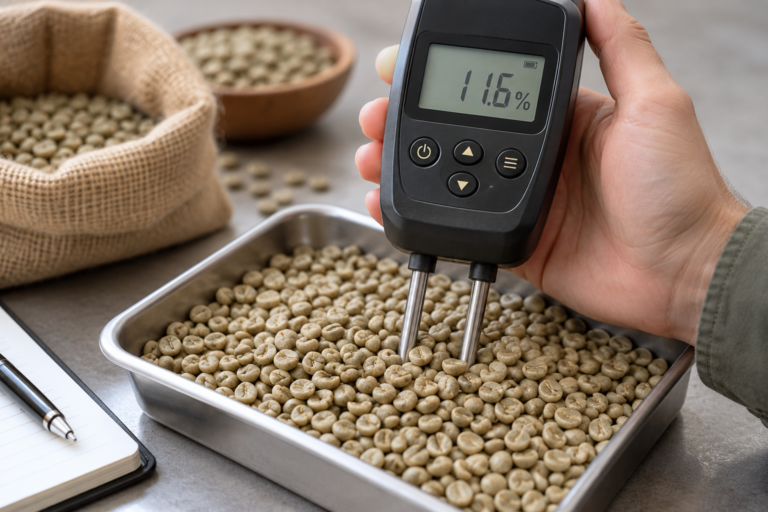
Raw-material condition can be observed in different ways, but accurate assessment of factors such as moisture requires suitable measurement methods. Surface appearance or touch alone is not enough to determine the condition of the whole bean or the entire lot.
Meaningful measurements also depend on sampling. When a lot contains different groups, sampling only one location may not capture its overall condition. Consistent methods and representative samples are essential if results are to guide subsequent processing.
Bean condition should be evaluated according to the requirements of the material and the roasting stage ahead, rather than by applying one fixed duration or temperature to every batch. What matters is the suitability of the result, not an arbitrary time on the clock.
How pre-roast stability relates to the cup
Coffee drinkers notice differences in the cup through aroma, taste and texture, while the condition of beans before roasting is much less visible. Yet this earlier condition can influence how evenly coffee develops when heat is applied. It is one link between careful raw-material handling and the finished sensory experience.
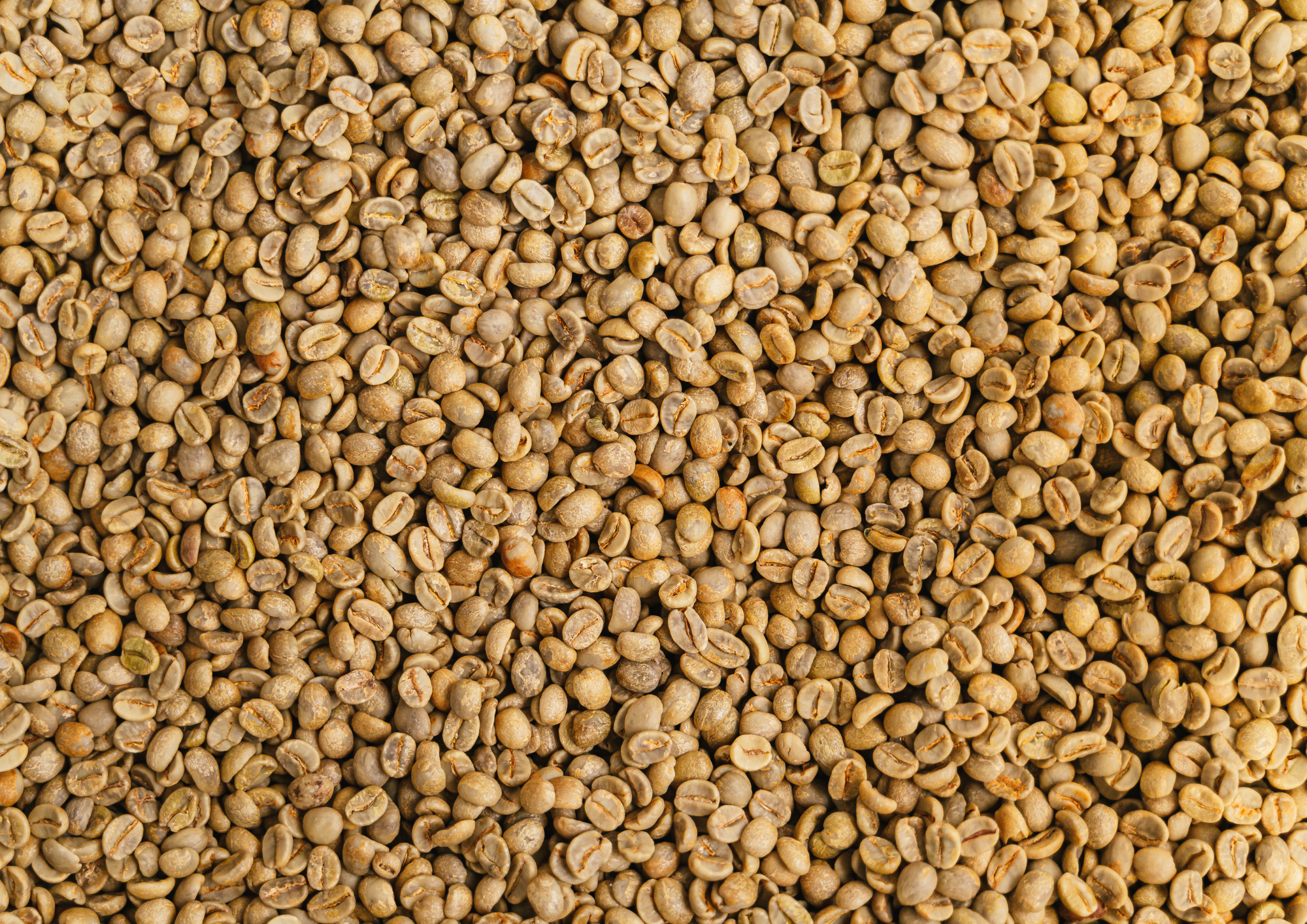
This does not mean that stabilisation immediately creates a new flavour whenever it is performed. Arabica naturally differs from Robusta, and each roast depends on many factors. Stabilisation is best understood as a way of preparing suitable conditions for roasting rather than as a shortcut to one particular tasting note.
In the way LOPHA describes pure coffee, technology is linked to respect for the natural character of the raw material. Pre-roast stabilisation belongs to that philosophy: it helps the beans proceed to flavour development in a condition that can be better managed.
What bean stabilisation means at LOPHA
A sound production process pays attention not only to its most noticeable machines, but also to preparation and stabilisation stages. These quieter operations contribute to the ability to control quality throughout the line.
Bean closing does not mean all water disappears from the beans or that every aroma compound becomes completely ‘locked inside’. A more useful explanation is that the beans are stabilised and their condition prepared before roasting.
Looking back from fresh cherry through green coffee and LOPHA’s factory process, we can see that a cup of coffee is not shaped by one outstanding machine. Each connected stage helps the next one do its job, including this important preparation before roasting.