Surface Contaminants and the Limits of Ultrasonic Coffee Cleaning
Summary: Ultrasound is often imagined as a deep-cleaning method capable of removing every impurity. In reality, its effects depend on where substances are located, the treatment conditions and the surrounding stages. Distinguishing material attached to a bean's surface from substances that have penetrated the raw material helps explain both the capabilities and limits of the technology.
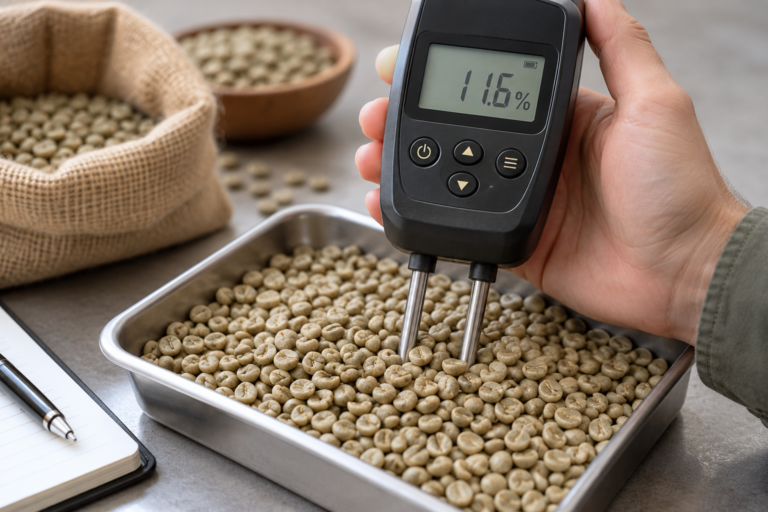
A green coffee bean passes through many environments before roasting. Dust, sediment and other material may remain on its surface, sometimes in places that are hard to see. That is why cleaning stages need to be organised carefully. But an important question remains: if a technology cleans the surface effectively, can it also remove everything that exists inside the bean?
Those two situations should not be treated as equivalent. LOPHA uses ultrasonic technology within its coffee-processing sequence, but understanding its limits is just as important as understanding how it works. Being specific about the impurities involved helps avoid exaggerated promises and appreciate the purpose of every stage.
1. Where can unwanted substances be found on or in a coffee bean?

First, some material sits on the surface or clings to uneven areas of the bean. This can include dust, residue or matter picked up during processing. Screening and rinsing may reduce some of it; other deposits may require more suitable cleaning conditions.
A second category involves substances or changes that are not confined to the outside. If material has penetrated deeply into the bean tissue, or the problem concerns the bean's own structure, the approach must differ. Cleaning the surface is not proof that everything inside has changed or been removed.
Adhering contamination must also be distinguished from intrinsic bean defects. An insect-damaged, black or spoiled green bean does not become good raw material simply because its dust has been washed away. Likewise, a stone in a sack is not residue attached to the bean and may require a different sorting stage.
2. How does ultrasound support cleaning?
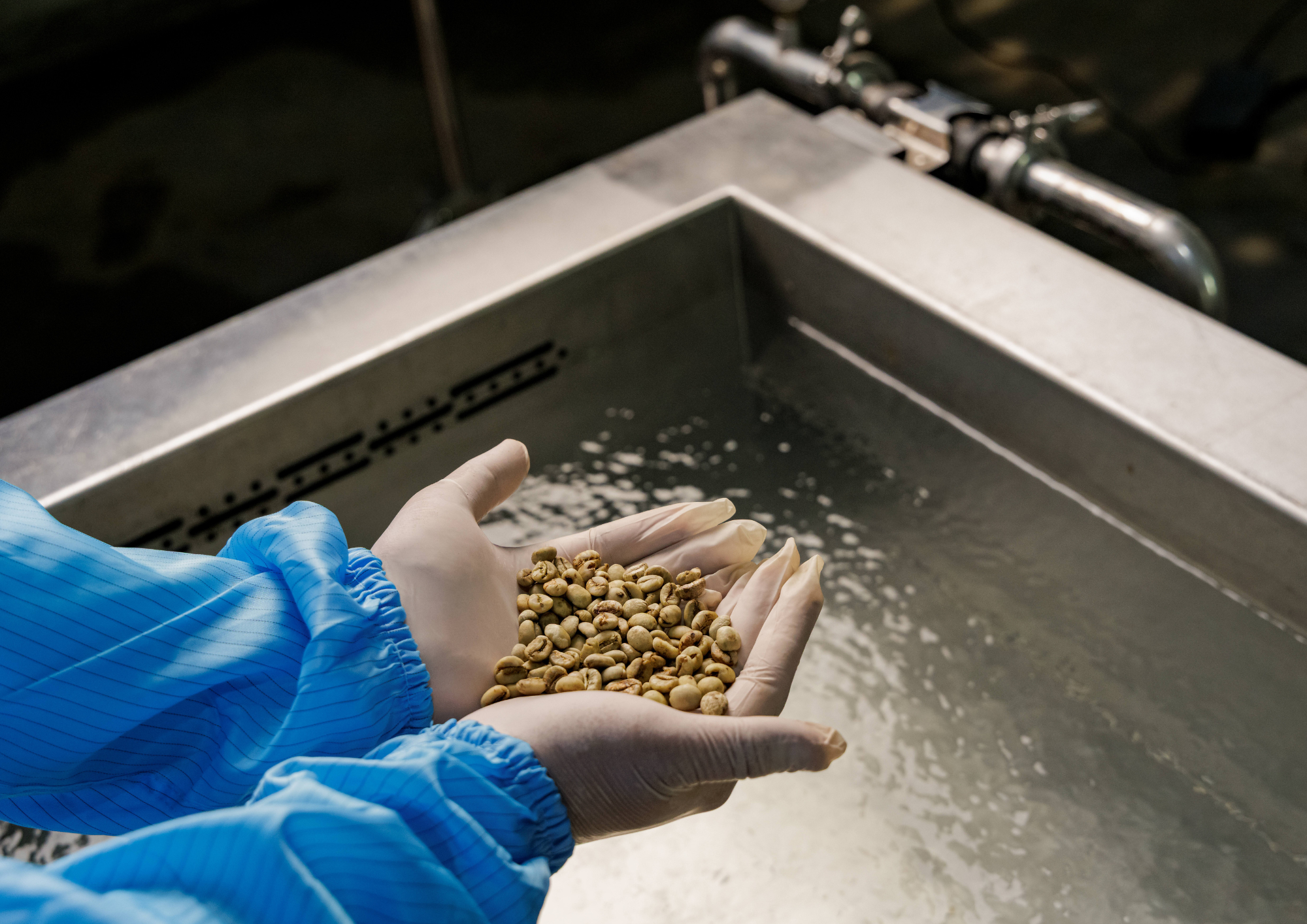
In a liquid medium, ultrasonic waves can generate tiny physical phenomena often described through the formation and changing behaviour of microscopic bubbles. Under suitable treatment conditions, effects near the surface may help loosen or detach certain substances adhering to the raw material.
2.1. Physical effects near the bean surface
Coffee beans are not perfectly smooth like glass marbles. Their grooves and uneven areas can hold residues that ordinary rinsing may struggle to reach. Physical effects in a liquid can support cleaning in such areas, depending on the deposit and operating conditions.
That does not mean every type of residue will detach to the same extent. Results also depend on water quality, raw-material condition, treatment time, energy conditions and rinsing afterwards. Without suitable conditions, actual outcomes may differ from expectations.
2.2. Surface treatment is not the same as 'absolute cleanliness'
A substance that has penetrated deeply into the bean cannot simply be assumed to disappear because the surface was cleaned. Even for external contamination, determining the extent of reduction requires suitable testing rather than relying on beans looking brighter.
Claims such as 'removes all residues completely' or 'eliminates every microorganism' should therefore not be made without direct evidence broad enough to support them. Understanding the technology's limits makes product information more accurate and trustworthy.
3. Why are other cleaning steps still necessary after ultrasound?
In LOPHA's 15-step journey, ultrasound follows selection, mechanical preparation and preparatory heating. Rinsing and pre-roast stabilisation come afterwards. The sequence matters because each stage addresses a different set of needs.
Screening can remove foreign objects that do not belong among the beans, while ultrasound creates cleaning effects within a liquid. Post-treatment rinsing helps carry away loosened material or remaining residues under suitable conditions. These are not simply different names for the same operation.
Without preliminary cleaning, larger foreign objects may remain even after surface treatment. Without rinsing after ultrasound, detached residues may remain in the processing medium. Ultrasound is therefore best understood as part of the full sequence, not a 'miracle' that replaces every control before and after it.
4. What factors can change cleaning effectiveness?
Not every green coffee lot is alike. Bean surfaces differ in initial cleanliness, shape, outer-layer condition and the kinds of deposits present. The same treatment sequence will not necessarily produce identical changes in two very different groups of raw material.
The processing environment matters too. Water quality, batch loading and contact with the liquid can influence results. Beans packed too densely or exposed unevenly may make treatment harder to evaluate and optimise.
Equipment conditions must be managed for their specific purpose. Yet operating parameters should not be presented as universal factory standards without confirmation. Figures for frequency, time or the intensity of physical effects do not, by themselves, establish how clean a coffee lot has become.
More important are the questions used to assess the result: which indicators changed before and after treatment? How were samples taken? Was the test method suitable for the contaminant of interest? This is a more realistic way to evaluate technology than simply saying a treatment is 'very powerful'.
5. Does surface cleaning change coffee flavour?
Coffee flavour develops through raw material, post-harvest processing, roasting and brewing. Cleaning may be part of raw-material preparation, but every flavour change should not automatically be attributed to ultrasound without suitable comparisons.
For example, two samples brewed after different roasting levels or grind settings may taste different even when they received identical cleaning treatment. Understanding a technology's specific contribution means considering multiple variables and evaluating them consistently. Coffee drinkers do not need to do this every day, but the distinction helps separate claims from evidence.
LOPHA uses ultrasound as a distinctive element of its production system. The most persuasive value of the technology is not a promise to remove everything, but its defined place alongside incoming-material selection, rinsing, roasting and inspection throughout LOPHA's coffee process.
6. How should buyers interpret cleaning claims?
When reading a product claim about cleaning effectiveness, begin with its exact wording. Which unwanted substance does the technology address? Is the effect on the surface or throughout the material? Under what conditions was it assessed? The same percentage can mean quite different things when it refers to different measurements.
A result measured on one lot or group of samples does not automatically become a fixed effectiveness level for every product. Likewise, a production-system certification is not a test certificate for the effectiveness of an individual ultrasonic stage. Understanding those different scopes helps us assess quality calmly and realistically.
There is no need to panic whenever dust or microbes are mentioned in relation to an agricultural product. Coffee production needs appropriate controls, and information shared with customers must be accurate. Being open about a technology's limits does not reduce its value; it helps build lasting trust.
7. Ultrasound brings value as part of the entire cleaning journey
Ultrasound may help remove certain types of contamination adhering to coffee-bean surfaces, but it should not be portrayed as completely replacing screening, rinsing or early raw-material control. Every stage has its place and purpose.
In the finished cup, drinkers cannot see the individual effect of each step. They can, however, understand that careful production means not neglecting necessary work: selecting beans, separating foreign objects, treating surfaces, rinsing, preparing for roasting and monitoring finished-product quality.
For LOPHA, ultrasonic technology is a meaningful distinction when explained in context. Understanding what it can support, and what it should not promise, makes the story of pure coffee more credible, approachable and connected to the real value of each bean.